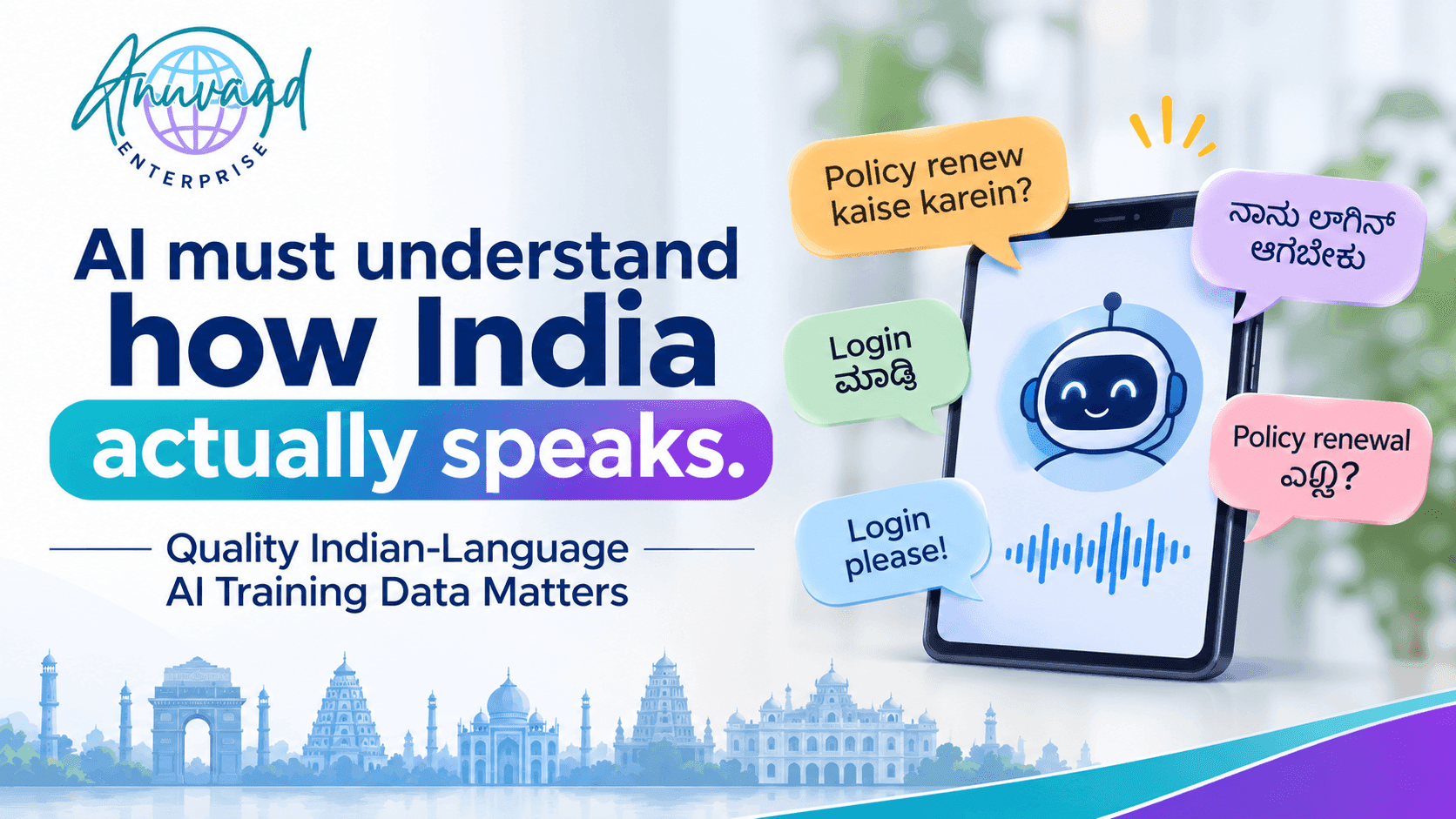
Real users in India don't communicate in textbook sentences.
They type "policy renew kaise karein". They switch between Hindi, Kannada and English, sometimes in the same sentence. They spell the same word three different ways depending on the phone, the keyboard and the mood.
That is how people actually communicate. Yet many AI systems, from customer-service chatbots to voice assistants and search tools, still struggle with these everyday patterns. The model answers fluently in English and stumbles the moment a user writes the way they speak.
The challenge isn't always the model. Often, it starts with the data.
Why Indian-language data is different
Most AI training data for Indian languages is either scarce, scraped from formal sources such as news and government text, or translated from English. None of these reflect real usage:
- Code-mixing is the norm, not the exception. Hinglish, Kanglish and Tanglish are how millions of people message, search and speak every day.
- Scripts and transliteration overlap. The same word appears in Devanagari, in Kannada script, and in Roman letters, often with inconsistent spelling.
- Dialects vary by region. Kannada in Mysuru, Mangaluru and Dharwad differs in vocabulary and tone. So does Tamil between Chennai and Coimbatore.
- Domain terms rarely have one standard form. Banking, insurance, healthcare and telecom vocabulary shifts by region and by company.
A model trained on clean, translated or narrow data learns those gaps and repeats them at scale.
What high-quality Indian-language AI training data requires
1. Native-speaker data collection
Prompts, conversations and voice samples should be gathered from real speakers across regions, age groups and backgrounds. A dataset built only from one city or one demographic produces an AI that only understands that group.
2. Code-mixed language data
Hinglish, Kanglish and Tanglish aren't edge cases. They are a core part of how people communicate and should be deliberately represented in training datasets, in both native script and Roman transliteration.
3. Consistent annotation
Intent, entity, sentiment and topic labels need clear, language-specific guidelines. Without them, two annotators will label the same sentence differently, and the model learns noise instead of meaning. Regular agreement checks keep labelling consistent across languages and over time.
4. Cultural and contextual review
A response can be grammatically correct yet still sound unnatural, irrelevant or culturally out of place: too formal, too blunt, or using a word that carries a different meaning in a particular region. Native-language reviewers catch what automated checks miss.
5. Multilingual evaluation
Once a model is trained, it needs testing in every supported language. Are its answers accurate, natural, contextually relevant and safe? Structured, scored evaluation by native linguists shows exactly where the model needs more or better data.
Beyond translated datasets
Translating an English dataset into Hindi or Tamil is a quick way to start, but it produces text that sounds translated, because it is. It misses the phrasing, slang and code-mixing real users bring.
For India's multilingual AI ecosystem, good data means building language resources that reflect how people actually speak, write and communicate, then checking them with people who live in those languages.
Questions to ask before you start
- Which languages, dialects and regions do your users actually come from?
- Do you need text data, voice data, or both?
- Is code-mixed and transliterated input part of the scope?
- Who writes and owns the annotation guidelines for each language?
- How will you measure quality: annotator agreement, spot checks, or model evaluation?
How Anuvaad helps
Anuvaad Enterprise supports AI and product teams with Indian-language data collection, annotation and linguistic review, drawing on native linguists across 100+ Indian and global languages. We combine AI-assisted workflows with expert human review, so the data your model learns from sounds like the people it will serve.
Talk to our team about your AI language data needs.